The Colombian situation is facing a structural turning point. While macroeconomic figures can show growth in the production and export figures, the production base of the grain experiences the exhaustion of the traditional model, marked by an average age of 54.5 years for the drivers and a high rate of rural youth migration in the country. This ageing is not just a social indicator; it is a direct economic risk for the coffee sector and the country's position on the international market. The lack of population replacement, where 38.5% of the drivers are people over 60 years of age, while only 2.7% are young between 18- 28 years of age, shows the inefficiency of the transition models against the demands of the modern economy. If the current structure remains unchanged, the Colombian situation is exposed to a productive precipice and, therefore, the fall in export volumes and lower foreign exchange income to the country leads to the loss of competitiveness in the global coffee market.
Demographic structure of the Colombian situation
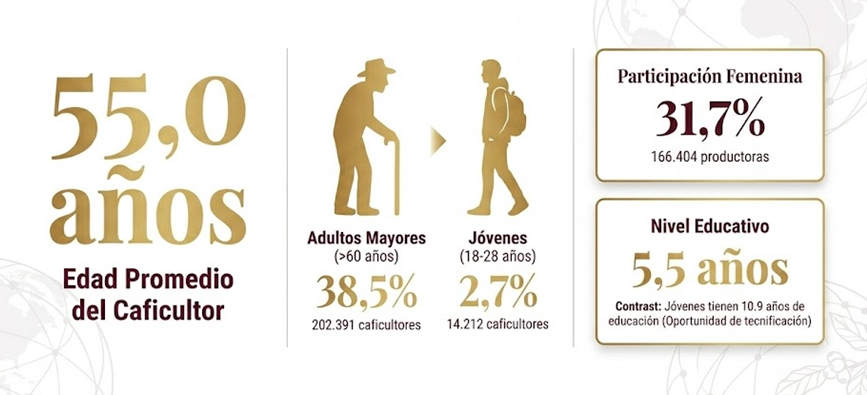
Source: FNC, SICA.
In a country whose competitive advantage depends on selective manual collection on steep slopes, the loss of physical capacity will increase the marginal cost of collection and increase the risk of quality loss in the harvest, exposing the country to a progressive loss of competitiveness and volumes exported against competitors with higher mechanization, such as Brazil (which is 27% of the supply) and Vietnam (17%). Colombia, by concentrating approximately 8 per cent of the supply, has no room to compete on mass scales or to lower labour costs.
Current challenges of the generational relief
In many traditional coffee-making areas, the non-early delivery of the farm administration acts as an expulsion factor, pushing young people to seek independence in urban centres. The historical approach to public policy has also preferred subsidies to basic inputs rather than financing the comprehensive modernization of productive unity. For contemporary rural young people, who have more schooling and digital access, a sustainable subsistence model, management autonomy and connectivity is without incentives.
The current challenge is to connect a consumer who requires immutable traceability and strict regulations (such as the EUDR Regulation) with a new generation that has the technical capacity to implement digital platforms, making it necessary to move towards a technicalized generational relay. The direct export processing mechanism operates through a sequential process that captures previously diluted margins. This process begins with Agrotechnology (AgroTECH), where the adoption of Internet of Things (IoT) and IA micrometers in production areas allows to stabilize yields, monitor bioclimatic variables and generate verifiable data from sowing.
The new technicalized environment
The next link to the mechanism is radical traceability and Blockchain integration. The unchanging registration of each of the coffee cycles ensures regulatory compliance and allows consumers in cities such as Tokyo or New York to verify the traceability of the origin of Colombian coffee through QR codes. Finally, digital marketing and Dropshipping complete the cycle, where young people, using cross-border e-commerce platforms, tweet, pack in origin and manage last-mile logistics, retaining part of the commercial value.
For this ecosystem to be consolidated, institutional interventions have developed retention initiatives such as the Rural Capitalization Incentive (ICR) and the Agricultural Input Access Fund (FAIA) provide the necessary liquidity for the small producer. At the same time, training initiatives such as the FNC's School and Coffee project certify young people to rules of agribusiness competition. At export level, institutions such as ProColombia deploy the "Export Training Hall" to train in customs regulations, and the "Real Academy of Coffee" form on sensory science and intellectual property licensing.
Despite these advances, strategic failures remain, which have not allowed the generational relief of the young people to advance in the Colombian situation. Assuming that paying premiums to the older owner retains the young person without giving him direct participation, or maintaining exclusive credit schemes based exclusively on land ownership, are practices that limit the development and retention of youth in the Colombian situation. To correct the course, financial instruments that accept export contracts and digital assets are required as guarantees, in addition to institutional KPIs focused on traceability adoption.
In order to promote the development of national difficulties and to promote the retention of young talent through clear incentives, it is imperative to consolidate advanced training spaces. In this context, the 90th Coffee Summit is positioned as a high-level technical platform to be held in Cartagena on 5 and 6 November. Its academic agenda will address the most urgent challenges of the sector and foreign trade, consolidating itself as the key scenario for strategically structuring the generational relief of Colombian coffee.
In conclusion, the problem in the retention of youth in difficulty lies in an inefficient incentive model that concentrates risks at source. Inaction against this demographic reality, coupled with inescapable climatic and regulatory pressures, will precipitate the inability of the coffee family economy and restrict access to high-value international markets. On the contrary, a technical process of generational relief provides a structural correction by integrating precision agriculture, traceability and e-commerce, aligning young people's technical capacities with the stringent demands of the global consumer. The future and hegemony of the industry require the design, financing and technology of this transition to ensure the operational sustainability of the value chain of Colombian coffee.