After a first quarter in which coffee production experienced a historical fall of 33.5% due to prolonged water saturation, the weather models of IDEAM confirm a radical investment in climate patterns. The likelihood of consolidation of the warm phase has risen to 82% from May, with a path that aims to reach levels of 90% by September. These forecasts not only suggest a change of season, but also that experts warn about the imminent formation of a "Super El Niño," a phenomenon characterized by anomalies in the surface temperature of the equatorial Pacific sea equal to or above 2.0 ° C, comparable to the critical events observed in 1997- 1998 and 2015- 2016. In the face of this transformation, a fundamental tension arises for the coffee-growing export ecosystem: Will this climate transition drive a technical recovery of the volume of supply or, on the contrary, will it deepen the vulnerability of the business in terms of quality and profitability?
Probability of the child 2026-2027
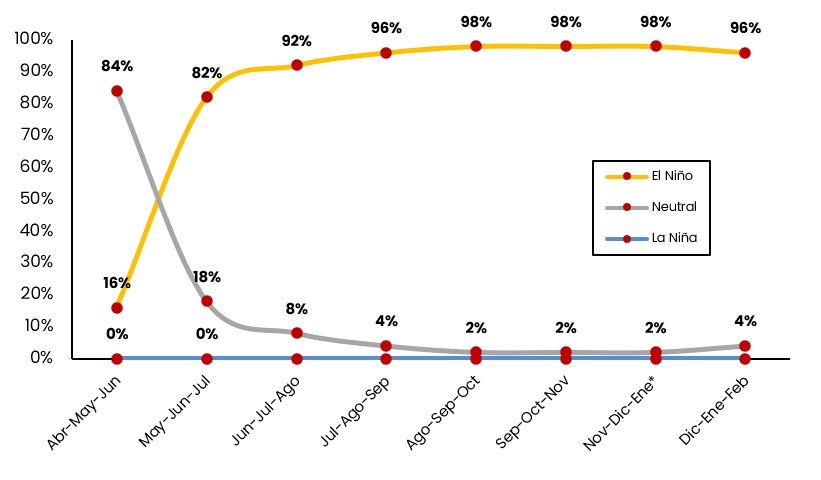
Source: IDEAM
Unlike other agricultural activities, the development of the situation in the Colombian Andean region is closely conditioned by the availability of light. During the recent events of La Niña, the excess of rain and the constant reduction of PAR - Photosynthetically Active Radiation generated a state of asphyxiation in the cafes, interrupting the stimulus for flowering and resulting in the current reduction of supply. In contrast, the initial phases of El Niño offer a controlled water deficit environment and abundant luminosity that recondition the plant's floral tissue. This condition stimulates a greater photosynthetic capacity that paradoxically favours the coffee sector in the short term. Corficolombiana's data support this dynamic: while the GDP of the agricultural sector would grow 0.5 percentage points less during El Niño periods (falling from 2.5% to 2.0%), the coffee sector has a positive performance, increasing its growth rate of 2.4% in a scenario without El Niño, to a2.6% under this scenario.
The Inflexation Point: Water Stress, Performance and Taza Quality
While the initial light stimulus benefits from cultivation, the prolongation of drought and the transition to a "Super El Niño" generate a break in agronomic and financial viability. When the water deficit coincides with the critical stage of cell expansion and filling of the fruit (between the third and sixth months after flowering) the metabolic process stops. This can trigger the proliferation of grains with defects, low density wrinkles and reduced weight. This irreversibly alters the cup profile that characterizes Colombian origin.
In addition to the physical degradation of the fruit, the thermal increase triggers a critical biological alert. The reproductive cycle of the coffee brush is highly temperature-dependent. Evaluations indicate that an increase of just 1 ° C above normal averages accelerates the reproduction of the insect that allows the overlap of multiple generations, raising the levels of infestation up to a29% in coffee areaslocated below 1,200 metres of altitude. In addition, environmental dryness inhibits the development of natural controlling fungi such as bassian Beauveria.
For the exporter and the trilla plants, the problems arising from the defects in the fruit and the pest attack directly affect the performance factor in the trilla process and possibly the utility of your business. In addition to this challenge, during the El Niño phenomenon, there may be a risk of a possible structural energy contingency; a scenario to which it is appropriate to be alert, since the processing of post-harvest in the large profit and grid complexes depends on an intensive use of electrical energy to operate it and the country's energy generation infrastructure is mainly hydroelectric.
In the face of the expected mass injection of71.4 million sacksby Brazil to the international market in 2026[1]Colombian competitiveness cannot be supported by the green grain volume dispute. It is essential to continue efforts in the competitiveness of the quality and differentiation of Colombian coffee. In addition, ensuring strict traceability and early alignment with European environmental regulations, such as the EUDR, will ensure that consolidated inventories do not lose their viability of access to mature markets that pay proven sustainability premiums.
An assertive strategy requires effective segmentation of the commercial portfolio, with the international industry of soluble and flavouring extraction, ensuring compliance with standards on moisture and control of mycotoxins, thus monetizing a fraction of the volume that was traditionally assumed as process loss.
On the agronomic level, the supplier firms should promote assistance programmes aimed at carrying out the fertilization work during the interdry windows, as well as insist on the exhaustive collection of the lots to minimize the interharvest reservoirs where the brush is housed.
The institutional projections for the second half of 2026 point to an improvement in production. While this would mark a recovery over the first half of the year, it will have a heterogeneity that will require extreme logistical efficiency and quality profiling since the purchase. The Colombian exporting sector must not only navigate El Niño's own biological disruptions, but also transform them through innovative strategies in marketing channels.
These strategic guidelines, the management of supply in times of drought and the tools of coverage against exchange rate and climate volatility, will form the pillars of the agenda of the90 Coffee Summitfrom Asoexport. This fundamental space for business development will be held in Cartagena on 5 and 6 November 2026, consolidating itself as the ideal scenario for industry leaders to track the road map that will ensure the competitiveness of agro-industry in the face of the new global landscape.