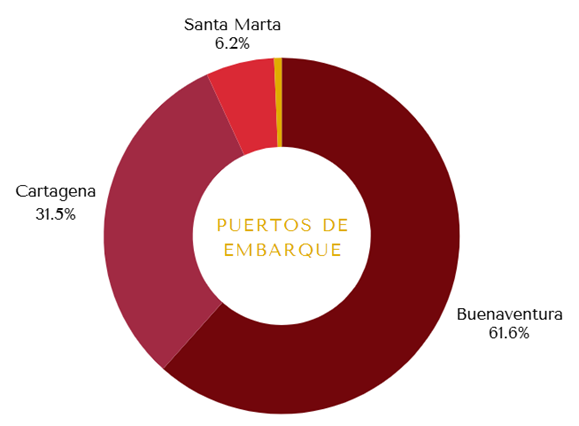
The port logistics strategy for the departure of Colombian coffee is concentrated on three main nodes. According to DIAN's 2025 export information, Buenaventura dominates the operation with a share of 61.6% and more than 8 million sacks exported, consolidating itself as the country's main artery. Cartagena follows with 31.5% (4.2 million sacks) and Santa Marta with a strategic niche of 6.2% (800 thousand sacks). This volumetric distribution is not random; it responds to a matrix that crosses the proximity of the trilla centers with the vocation of each terminal and the offer of direct maritime routes.
Ports of departure from Colombian coffee, 2025
Source: Prepared by Asoexport with DIAN data
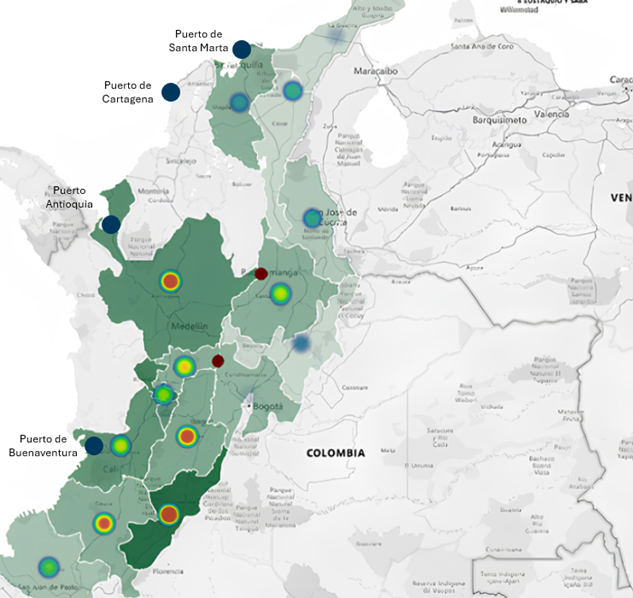
The logistics operation of coffee works under a strict impact chain: the origin determines the road transport distance, this distance defines the internal transport costs, and the chosen port conditions the transit time and climate exposure. Good adventure, with its high levels of precipitation and relative humidity, requires strict packaging protocols for green coffee, but its proximity to the Huila —department that provides 22.5% of the country's exports and is the main productive epicenter— the economic justification for its use by minimizing land transit. In contrast, the Atlantic coast (Cartagena and Santa Marta) offers a drier climate, reducing the risk of condensation in containers during waiting times, a critical factor for processed products.
Main coffee areas and ports of departure
Source: National Coffee Federation.
The analysis of the 3 main ports:
The impact of this distribution is evident in the logistical specialization of each port node. The central idea of Buenaventura is to operate as the Pacific exit and the country's main volumetric channel. As for product types, this customs office concentrates the export of green coffee, which represents 95.19% of its traffic. The origin of this volume is based on production departments such as Huila and Caldas. With regard to destination, it channels the flow to the United States, with a share of 33.45%, and to larger Asian markets such as Japan (8.8%) and South Korea (6.1%).
For its part, Cartagena's operational idea is to consolidate itself as the axis for value added export. According to the types of coffee, 11.77% of its volume corresponds to soluble coffee (equivalent to 55.5% of the national total of this type of coffee) and 3.39% to roasted coffee. The origin of this load comes mainly from departments with processing capacity such as Antioquia, which provides 30.67% of the terminal's exits. In relation to destination, its traffic is concentrated in North America, with the United States receiving 55.23% and Canada receiving 13.06%.
Finally, Santa Marta is a strategic terminal for the European market, maintaining an export corridor to the collection ports of that continent. The source of its load is concentrated in Caldas and Huila, departments that supply 65% of the terminal volume. As for the destination, Belgium and Germany receive 63.1% of their offices, centralizing the reception of the goods to European destination.
The logic behind the export logistics
The selection of the exit customs office based only on the sea freight fee limits the assessment of the full logistical cost. Factors such as land freight, transit times to the Pacific and the availability of storage infrastructure for processed coffee are variables that affect the FOB price (Free On Board) and may generate additional costs in the logistics operation.
In the face of this scenario, distribution planning opens up the need to jointly structure and analyse land and maritime costs. The assessment of the cost-distance ratio raises different routing alternatives for coffee, such as the option to use Cartagena for finished products to the east coast of the United States, or the Buenaventura alternative for the volume of green coffee from the south of the country to Asia or the west coast of the United States. The coordination with the routes of the shipping lines and the validation of food-suitable containers operate as continuous analysis variables within the supply chain of Colombian coffee.
If the national infrastructure advances according to development plans, the export logistics map will experience a structural reconfiguration in the short term. The entry into operation of Puerto Antioquia in the Urabá region will directly alter the current flows. Antioquia, which today refers 30.67% of the offices leaving Cartagena, will find a sea exit with less land distances. This will increase competitiveness for traditional ports on the Caribbean coast and especially for important Colombian coffee origins such as Antioquia and the Coffee Axis.
The projection of these changes in the infrastructure, specifically the impact of Puerto Antioquia, was one of the central themes of the academic agenda at the 89 Coffee Summit. In order to deepen this analysis and address the logistical developments that impact the sector, the90 Coffee SummitThe next 5 and 6 November will be held. This meeting will allow a technical assessment of the competitiveness variables and the new load flow dynamics that are anticipated for the future of the industry.