The global coffee market is undergoing a phase of structural reconfiguration. Recent projections indicate a widespread increase in world production, which has put a downward pressure on the New York Stock Exchange on the C Contract.
This fluctuation in contributions responds directly to the offer reports issued by reference entities such as USDA and StoneX. For the 2025 / 26 cycle, the US Department of Agriculture (USDA) is planning a record world production of178.8 million sacks, exceeding 175.5 million in the previous period. This increase is driven mainly by the strong recovery of Vietnam —to contribute30.8 million sacks to market— and for the performance of the grain harvest in Brazil for the period 2026 / 27, which projects a harvest of75.3 million sackscompared to 65 million in the previous cycle.
In contrast, Colombia, the main reference in soft washed cafes, would experience a productive decline towards the12.8 million sacks in 2025 / 26, which would represent a 14% drop from the 2024 / 25 figure, due to an excess of precipitation that affected the florations. This divergence between external abundance and internal scarcity creates a strong global bassist pressure that contrasts base prices. It also complicates the export process in the country due to the asymmetry in price expectations among the various actors in the chain. When Brazil's projected volume increases, investment funds tend to adjust their positions, causing a fall in the base price of theNew York C contractthe perception of a market over supplied. This massive settlement consolidates the downward trend in the quotation of the Arabica. Ultimately, the impact is directly on origin: as the international indicator collapses, the domestic price base of purchase in Colombia is carried down. In this context, the traditional quality premium for Colombian coffee, although in force, is insufficient to safeguard the operational margins of market players.
International and domestic coffee prices (2024 - 2026)
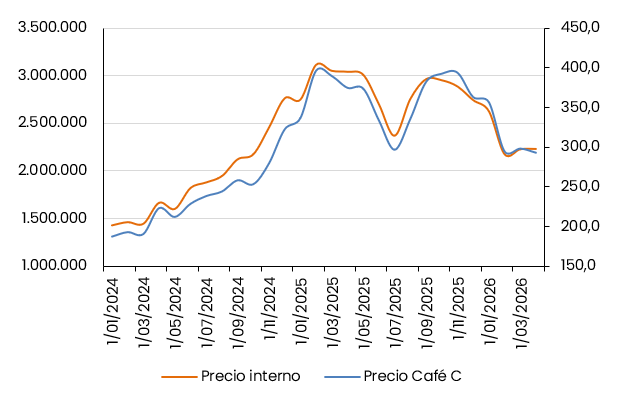
Source: Investing.com and FNC.
From the perspective of Asoexport, the conjuncture confirms that Colombian coffee needs to combine differentiation, commercial opening and risk management. The guild has insisted that quality remains the main asset of Colombian coffee and, although the current moment represents a risk, it also constitutes an opportunity to redirect sales, diversify destinations andstrengthen the positioning of Colombian coffee in markets that value quality, traceability and consistency.
In line with the above, it is necessary to move towards a more strategic and differentiated approach according to the role within the chain. For the producer, the priority should be to improve productivity and ensure a higher value supply through quality, specialization and certification practices. For the exporter, the challenge is to incorporate financial coverage and to read in advance the signals of the international market.
The supply and demand dynamics of coffee (Supply and Demand) will be decisive in deciphering price and market behaviour. Given its relevance, this analysis will be one of the central axes of the96th Coffee Summitthe next5 and 6 November in Cartagena. During the event, it will deepen the reaction of prices to these global and logistical movements. Under this scenario, success for the Colombian coffee sector will not be in predicting New York's ceilings or soils, but in applying disciplined risk management based on market intelligence.
Technical adaptability will, as usual, be our best response to uncertainty. In this sense, the fall in the international price of coffee does not respond to a single factor, but to the combination of greater global supply, speculative pressure, inventory adjustments and a weaker Colombian harvest than expected. In this context, in addition to the fundamental approach of thequality premiumthe country needstrade strategy, financial coverage and a more sophisticated market vision. The opportunity for Colombia is to move from a reactive logic to a management logic in which anticipation, diversification and risk management become fundamental pillars of the competitiveness of the sector.