International coffee trade experiences a reposition of its distribution flows, where the Asian continent consolidates its position as a fundamental demand block for Colombian supply. The evolution of consumption patterns in Asia, coupled with the expansion of the purchasing capacity of this continent, has generated sustained traction in the import of agricultural goods.
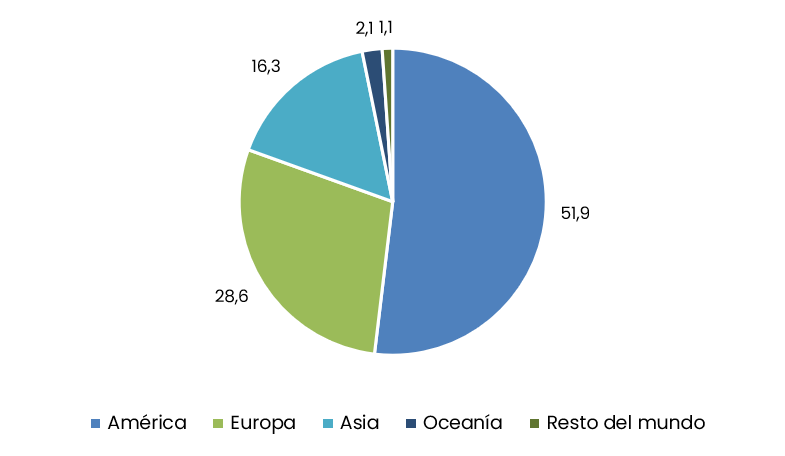
Participation of the destination continents of Colombian coffee
Source: Prepared by Asoexport with DIAN data
The importance of market diversification lies in mitigating risks associated with concentration in traditional destinations. The 2025 data show that Asian economies not only absorb a significant fraction of the national harvest (16.3%), but also have differentiated consumption profiles that allow the marketing of different product lines, from raw material for the local tostion industry to finished products such as soluble coffee. Understanding these particularities allows exporters to align the offer with the specific regulatory requirements and quality standards of each jurisdiction.
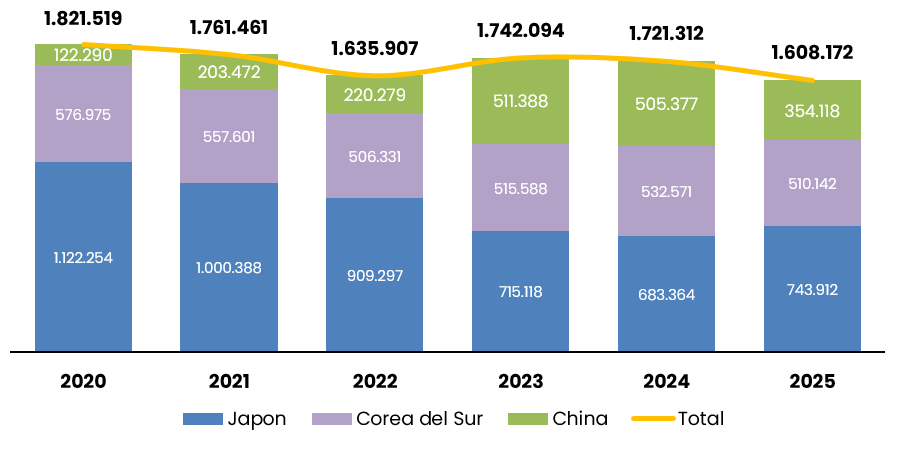
Exports of Colombian coffee to Japan, Korea and China, 2020-2025
Source: Prepared by Asoexport with DIAN data
Japan remains the largest market for Colombian coffee within the Asian continent, recording 743,912 bags of 60 kg exported in 2025. In view of historical behaviour, the Japanese market presented a transition from 1,122,254 sacks in 2020, going through a gradual adjustment to 683,364 in 2025, then showing an annual recovery of 8.9% at the close of 2025. As for the composition of these exports, green coffee constitutes 81.8% of the total, while soluble coffee represents a relevant share of 18.2%, characterizing Japan as a country with high consumption of Colombian industrialized coffee.
South Korea has a demand path for Colombian coffee characterized by temporary stability. During the period from 2020 to 2025, export volumes have fluctuated in a narrow range, starting at 576,975 bags of 60 kg and closing the recent cycle at 510,142 bags. This low volatility suggests consolidated supply relationships and internal consumption. The structure of exports to the South Korean market in 2025 is highly concentrated in green coffee, which covers 90.5% of shipments. The soluble coffee participates with 9.1%, and the toasted coffee maintains a marginal presence of 0.41%. The proportions show the South Korean industry's preference to manage the transformation process locally, adapting the tostion profiles to the specific requirements of its final consumers.
For its part, China represents the market with the fastest growth dynamics. The historical series shows significant quantitative, from 122,290 bags from 60 kg exported in 2020 to a peak of 511,388 bags in 2023. After this period of expansion, the figures experienced a correction, reaching 505,377 bags in 2025 and 354,118 in 2025. The segmentation of Colombian exports to China in 2025 confirms the high dominance of green coffee with 93.15%, followed by soluble coffee with 6.77%. The high proportion of green coffee exported is due to the accelerated development of the installed processing capacity on Chinese territory, which is intended to supply the growing distribution and retail network in its main urban centres.
At a second volume level within the Asian and Middle East region, other destinations are identified that play a complementary and strategic role for Colombian coffee exports. They particularly highlight Malaysia, Taiwan and Saudi Arabia, which maintain growth rates in 2025. Saudi Arabia leads this segment with a record of 140,476 sacks of 60 kg equivalent in 2025, exceeding 112,179 of 2025; this increase of 25.23% reaffirms a sustained growth trajectory evidenced over the last five years. Malaysia, for its part, exhibits the highest relative acceleration of this group but also a high historical volatility, reporting an advance of 26.07% from 89,992 to 113,456 bags exported in the same period. Taiwan accompanies this positive trend by reaching 96,364 sacks, an increase of 15.01% compared to the previous one. In contrast to the expansive dynamics of these three markets, Israel has a stabilization behaviour with a slight downward adjustment, from 98,162 sacks in 2024 to 95,305 in 2025, resulting in a moderate contraction of 2.91%. Overall, the figures in this block show clear opportunities for diversification to emerging markets that are consolidating their demand for Colombian grain.
Origin structure and output logistics in 2025
The analysis of the departments of origin highlights the Huila's role as the main source for the Asian axis. In 2025, this department led exports to South Korea with a share of 31.87% (162,580 units), to Japan with 24.98% (185,810 units), and to China with 23.74% (84,050 units) and was consolidated as the main origin for Asia with 27.6% participation. Antioquia and Caldas complement the largest supply base. The concentration of supply in these productive clusters indicates a standardization of processes and a high capacity to respond to the volume and quality requirements demanded by Asian importers.
From a logistical perspective, the Pacific port infrastructure has an absolute dominance in connectivity with Asia. The port of Buenaventura channeled most of the commercial flow in 2025: 730,610 units to Japan (98.2%), 506,721 units to South Korea (99.3%) and 339,477 units to China (95.8%), consolidating 95% share of exports to the total Asian continent. Customs on the Caribbean coast, such as Cartagena and Santa Marta, record additional volumes, with Cartagena being the second exit point, with 11,623 units to China and 6,625 units to Japan. The efficiency and operational capacity in Buenaventura are crucial for the competitiveness of Colombian coffee in the eastern hemisphere, as the maritime routes from the Pacific offer comparative advantages in times of transit compared to the alternatives of the Atlantic.
The rigorous monitoring of foreign trade variables, the evolution of logistics infrastructure and supply and demand trends in high-voltage markets such as Asian countries is a necessary analytical exercise for the development of sectoral strategies. The interpretation of these data makes it possible to anticipate adjustments in the trade balance and to adapt internal processes to international regulatory and quality standards. All these elements of analysis of the export market for Colombian coffee will be part of the academic agenda of the90 Coffee Summit. We invite all the actors in the value chain to participate and discuss these issues on November 5 and 6 at the Hyatt Regency Hotel in Cartagena, where the road maps will be drawn to strengthen the presence of Colombia's coffee in global scenarios.