The global coffee market passes through a turning point where the marketing of undifferentiated raw materials gives way to a model based on verifiable provenance. traceability is no longer a simple strategy of commercial differentiation, it is now a legal requirement for the marketing of grain.
The urgency of this transition responds to the convergence of two macroeconomic forces. On the one hand, the sustainable coffee market shows a material consolidation: the purchases of this segment have increased by 170% since 2018, reaching 1.7 million metric tons, representing the21% of global exports of green coffee. In this niche, consumers demand transparency and support this requirement with substantial premiums, raising the value of a cup of specialty coffee traceable to $5, which can represent a 20 to 30% increase in the sales price for the primary producer against uncertified grains.
On the other hand, international law is rewriting the rules on access to international coffee markets. Regulations such as the European Union Deforestation Regulation (EUDR) or the FDA Food Safety Modernization Act (FSMA) in the United States provide for a traceability of a system of origin for different agricultural products, including coffee.
The convergence between the consumer's willingness to pay for a demonstrable origin and strict compliance with the new legal sustainability requirements makes agricultural technologies a structural need. The adoption of digital tools for traceability is no longer an added value, but the basic technical requirement for maintaining commercial competitiveness and ensuring access of coffee to international markets.
To meet these requirements and capture the quality premium, fragmented digitization in spreadsheets is insufficient. The operating mechanism requires the adoption of an unbreakable ecosystem based on three interconnected technological layers.
The first layer is the Blockchain, which establishes an information structure through a decentralized and immutable accounting book. Throughout the coffee value chain, this system records operational data on transparency and traceability, specifying the origin, provenance and exact location of the product. The register also consolidates information on price fixing and the distribution of payments to producers, as well as quality metrics including variety, tasting score and performance factor. Finally, the platform documents validation processes, certification standards and audits, along with sustainability indicators that integrate social parameters —gender, age and working conditions— and environmental factors, such as the use of agrochemicals, the implementation of shadow trees, interspersed crops and water treatment systems.
Blockchain traceability model in the coffee value chain
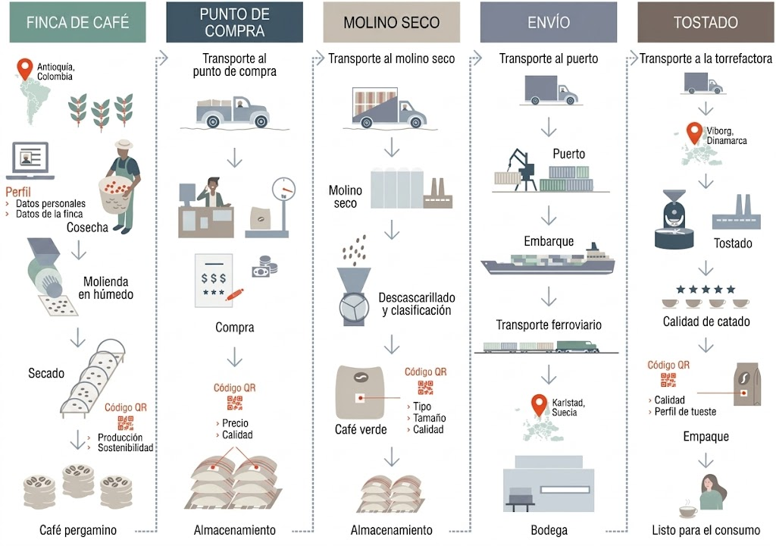
However, the effectiveness of the blockchain depends on the veracity of the data entered. Here comes the second layer: the Internet of Things (IoT). By physical sensors (hygrometers, weather microstations and thermometers), the empirical data capture on the farm and during transport is automated. In ocean transit, telematics monitor the humidity and temperature of containers in real time, independently recording any critical deviation in the block chain.
The third layer, the Artificial Intelligence (IA), processes these structured data. From predicting demand to optimizing inventories to implementing quality control through data. Advanced analytical models are already able to discriminate the geographical origin of coffee with a accuracy of more than 90% based on its volatile compound profile, giving exporters scientific evidence to international buyers.
One of the recurring strategic errors in the sector is to assume that technological implementation must be of an individual nature. Attempting a small dealer to assume the total costs of digitization, hardware and satellite connectivity leads to "digital isolation." The basic technological infrastructure does not cover recurrent costs of data transmission in complex geography or software licensing.
The right strategic action lies in the associative economy. Actors such as cooperatives or associations can act as central technological nodes. It is these entities that can finance the acquisition of licenses and servers, while the driver feeds the system through intuitive mobile offline registration applications on their personal devices. In addition, this motivates the use of institutional financial instruments such as the subsidized lines of credit for Productive Restoration (PECRP) of the Fund for the Financing of the Agricultural Sector (Finagro), key mechanisms for capitalizing on the transition to Agriculture 4.0.
At the macro level, Colombia has an initial strategic asset that places it in a advantageous position against other origins: the Coffee Information System (SICA). Managed by the National Coffee Federation, this cadastre consolidates the geospatial records of approximately 1.8 million land, serving as the primary institutional shield for diligent compliance with the new regulations on sustainability and the traceability of origin of coffee.
If technological adaptation is implemented quickly through associative models, Colombia will not only protect access to European and American markets, but will permanently capture the economic premiums of the special and value-added coffee segment.
Tracability is no longer a differentiating attribute; it is the most valuable transferable asset that accompanies the physical grain. Consolidating an immutable data ecosystem ensures the country's commercial leadership. In order to deepen the convergence of these regulatory, technological and market macrotrends, we invite all the actors in the chain to participate in the90th Asoexport Coffee Summitwhich will be held in Cartagena on 5 and 6 November 2026, where we will discuss in detail the competitive road map for agro-industry.