Coffee consumption is evolving towards more practical, personalized and more valuable experiences: ready-to-drink formats, cold coffee and home consumption grow strongly, while consumers prioritize quality, sustainability and well-being. The value proposal for the sector is expanded by integrating innovation into formats and traceability as key supplements to traditional export.
The global coffee market is undergoing structural developments. While world demand reaches a historical record of173.9 million sacksnew opportunities arise to capture value beyond the metric volumes of the raw material. The traditional idea of a standard hot cup now lives with an expanding ecosystem of functional, cold and ready drinks (RTD). For industry, understanding this transition represents a strategic opportunity to connect with a consumer who seeks experiences and benefits that complement the classic caffeine stimulation.
Consumption diversification: Cold, fast and functional
To understand the current picture, it is key to observe the dissociation that the new generations have made of coffee with respect to its thermal condition. At present, cold drinks are a significant portion, reaching up to a75% of total sales in large chainsin markets like the United States. This change of habit, driven by Generation Z and the millennials, generates a dynamic effect on the industry. The search for convenience has accelerated the market for ready-to-drink coffee (RTD), a segment that was valued at $26.2 billion in 2024 and plans to reach the52.5 billion by 2034.
Market size of ready-to-drink coffee (RTD) by product type, 2021- 2034
(Billions of USD)
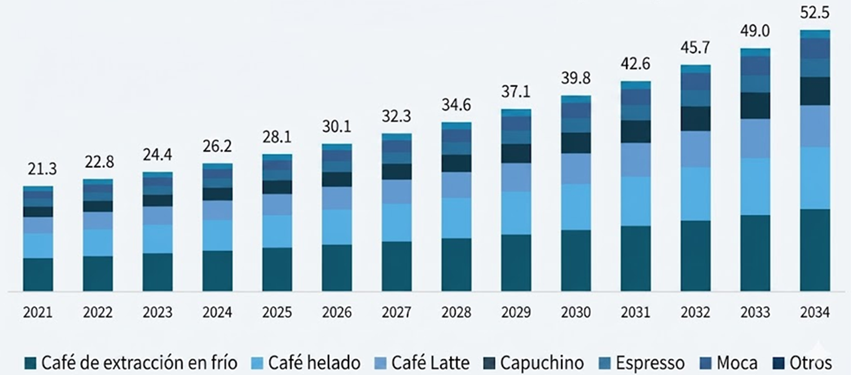
Source: Global Market Insights
At the end of 2025, the coffee market showed a clear segmentation. While the general sector shows a moderate growth of 1.3%, it is projected that the segment of special cafes will experience an expansion of 9.5% towards 2030. This trend sends a strong signal to industry: consumers are fully willing to pay for higher quality and for healthy attributes —In fact, 61% perceive coffee as a product beneficial to their well-being—.
The preference for soft and sweet profiles also encourages the creation of new formats, which in turn open the door to technological innovation for its scalability. A clear example is the implementation of ultrasound-assisted extraction, which allows to reduce the preparation times of thecold brew24 hours at an interval of one to three minutes. At the same time, coffee finds synergies with the macro-welfare industry. The modern consumer shows a growing interest in products enriched with functional ingredients,like the Lion Melena for the mental approach or the Reishi for stress modulationlooking for a balance between energy and well-being.
This evolution in habits constructively impacts the entire value chain, from exporters to retailers. One aspect to highlight is the resilience of the sector: data reveal that the74% of specialty coffee drinkers now enjoy their infusions mainly in the home environment, consolidating a new and valuable consumer space, compared to 35% of commercial cafés. In turn, consumption outside the home records unprecedented figures, showing that 59% of sales are channelled through self-service formats from the vehicle (drive-thru), mientras que las aplicaciones móviles ya gestionan directamente el 36% del volumen total de pedidos en el mercado.
El reto estratégico para la industria radica en complementar la visión centrada en los volúmenes tradicionales, reconociendo que el consumidor actual invierte en tecnología doméstica y prefiere modelos de suscripción, donde la compra es digital y el espacio físico funciona como un centro experiencial.
Ante este panorama dinámico, el sector cafetero tiene la gran oportunidad de enriquecer su portafolio comercial. Explorar la integración de formatos de valor agregado e implementar herramientas de trazabilidad a origen permite fortalecer la competitividad, especialmente ante regulaciones como el EUDR europeo. Asimismo, la transición hacia empaques inteligentes y bioplásticos se consolida como un estándar diferenciador clave para afianzar el posicionamiento en mercados premium.
A medida que estas tendencias avanzan, el mercado ofrece nuevas ventajas competitivas a las organizaciones que integren personalización, eficiencia logística y sostenibilidad demostrable. El momento actual, respaldado por la robusta demanda mundial, es el escenario propicio para que exportadores y productores exploren modelos que complementen y potencien la comercialización del grano, tanto verde como procesado. La oportunidad a futuro se encuentra en aprovechar la intersección entre la tecnología, la bioeconomía y la innovación aplicada, elementos fundamentales para continuar liderando la cadena de valor en un mercado global cada vez más sofisticado.