The export of Arabic coffee has an inescapable temporary tension: the business requires to acquire the raw material today in the production centres, but foreign currency revenues only materialize months later, when the grain is delivered to international toasters. During this window of time, the value of the stored inventories is completely exposed to the oscillations of the international market. If the global price is abrupt while the exporter has its full wineries without firm sales, the value of its assets is depreciated, threatening the solvency of the operation.
The indicator that dictates this rhythm is the "C" Contract, operated in the New York Stock Exchange (ICE). It is a common mistake to assume that the stock exchange imposes prices in an authoritarian way; in reality, it is a neutral platform where the supply and global demand for coffee converge. Drought, ice-cream or global inventory levels make this indicator go up or down every day. To survive in this environment, the modern exporter cannot simply move coffee bags; it must protect the value of its goods by means of financial tools known as cover.
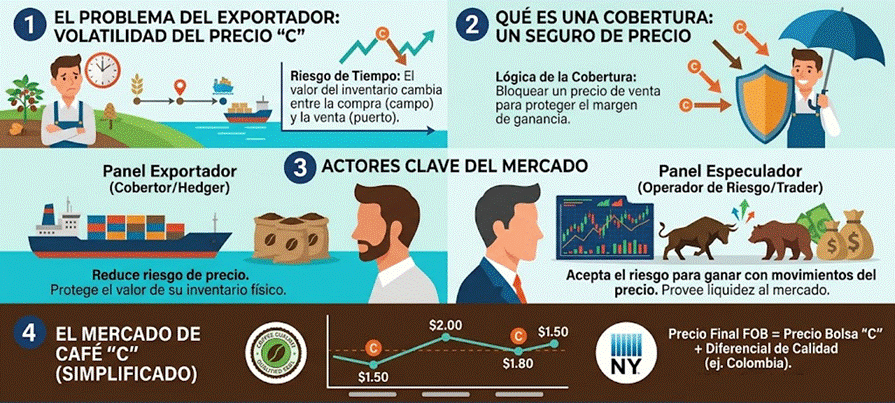
A stock market coverage is not a tool to speculate or guess where the market will go; it is a defensive maneuver against the volatility of the price of coffee run by the world's supply and demand forces. It works on the same principle as an insurance policy for a vehicle or a factory. The central objective is to transfer the risk of coffee loss from a fall in prices, armored operational profitability.
To understand how it is done in practice, let us imagine a realistic case: an exporter buys coffee from local drivers, keeps it in his cellar and plans to export it to Europe in three months. His greatest fear is that, during that waiting time, the international price will collapse and his inventory will lose value, forcing him to sell for less than it cost him. To avoid this situation, the exporter goes to the stock exchange and sells a futures contract, setting a sales price (for example, $2 a pound). If months later the market falls and the physical coffee is only worth $1.5, the exporter will sell his sacks at that low price, but the financial market will pay for the $0.5 of the difference I had secured. Thus, the commercial loss suffered in the winery is exactly offset by the profit obtained in the bag, saving the business.
Historically, exporters used only direct futures contracts to freeze their prices. However, in practice, this creates a deep liquidity problem. If the market behaves unexpectedly (for example, if prices go up violently after an ice cream), the stock market requires almost daily cash deposits to keep the positions open, which is known as margin calls.
To avoid the cash drain required by contracts, industry has massively adopted the use of financial options. Unlike futures, an option gives the exporter a right rather than an obligation. This difference is fundamental, as it allows for the design of accurate strategies to limit losses without stifling the company's liquidity.
To understand how the sector blends its inventories, it is necessary to isolate the three key instruments:
The Put Option:Otorga el derecho de vender café a un precio fijo. Es el equivalente directo a un seguro de caídas. El exportador paga una prima inicial. Si el mercado internacional colapsa, la empresa está tranquila porque ya aseguró un precio mínimo de venta que cubre sus costos operativos. Si los precios suben, simplemente no usa la opción y vende su café físico más caro en el mercado.
La Opción Call:Otorga el derecho a comprar a un precio máximo establecido. Protege a quien necesita adquirir materia prima a futuro y teme que una escasez dispare los costos, como por ejemplo un tostador que necesita café para su empresa. Al tener un Call, la empresa sabe exactamente cuál será el límite máximo de su presupuesto de compra, independientemente de los cambios de mercado
En un mercado de precio volátil como el del café, afectado por alteraciones climáticas y dinámicas geopolíticas y normativas globales, el mercado depurará a los actores que mantengan sus inventarios desprotegidos. Implementar esquemas asimétricos, como los túneles de cobertura, permite al negocio enfocar sus esfuerzos en la calidad, la logística y la sostenibilidad, delegando el riesgo de los precios a la infraestructura bursátil.
Es imperativo que el sector unifique criterios y profesionalice sus mesas de trabajo para dominar estas herramientas. Precisamente para estructurar soluciones viables, analizar tendencias de financiamiento y trazar la hoja de ruta de la industria, lo invitamos a participar activamente en la90 Coffee Summitde Asoexport. Este encuentro central se llevará a cabo los días 5 y 6 de noviembre de 2026 en las instalaciones del Hotel Hyatt Regency en Cartagena. Allí, convergerán los líderes de la cadena de suministro para definir cómo la certidumbre financiera será el pilar de la próxima década exportadora.