Volatility has become the norm of coffee markets, but a constant prevails: when Brazil moves its chips, the whole world feels the impact.
With a domain that covers 37% of world coffee production, the expectations of a record harvest in the South American giant threaten to saturate a market that until recently suffered from historically low inventories.
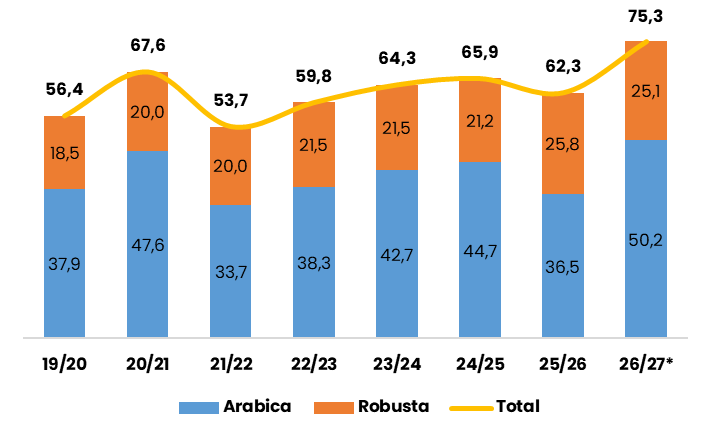
During the 2025 / 26 cycle,the production of Arabic coffee in Brazil has experienced a fallattributed to high temperatures and droughts in key regions such as Minas Gerais and São Paulo, returning from 44 to 36.5 million sacks in the last Brazilian coffee year 2025 / 26 (The coffee year in Brazil includes the Julian-June period). For its part, the production of robusta reached an estimated record of 25.8 million sacks, in the same period, counteracting the productive decline of the arabic. Despite the low performance of the grain supply in Brazil in 2025 / 26, forecasts point to a great leap in production for the next period. StoneX estimates project that, for the 2026 / 27 cycle, the country will achieve a production of coffee from75.3 million sacks. This volume transforms the narrative of a global deficit into a potential surplus that will redefine the fundamentals of the market.
Brazilian Coffee Production 2019-2027*
Source: Prepared by Asoexport with StoneX data
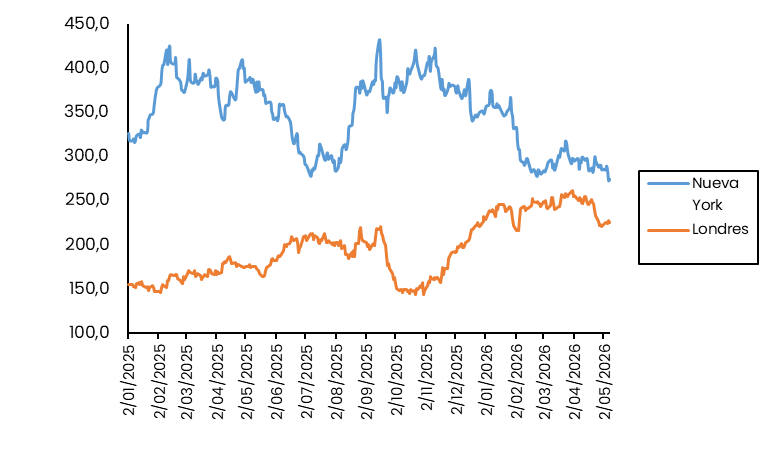
The injection of high volumes of Brazilian robusta increased the global supply and motivated the toasters to modify their mixtures to contain costs, with a robust price well below the arabic. However, the market anticipates a reversal of this scenario in the short term. While the fall in Arabic production during the 2025 / 26 harvest resulted in high prices, the projections for the 2026 / 27 cycle indicate a significant recovery in the production of this variety thanks to favourable climatic conditions in the Brazilian giant. The expectation of a higher volume of supply already puts pressure on the market, which has been reflected in advance in the downward trend in the price of the C Contract in the New York Stock Exchange during the run of 2026.
Prices of Arabic and robust coffee 2025-2026
Source: Prepared by Asoexport with data from Investing.com
Impact on the value chain and strategic readjustment
This projected increase in Brazilian supply represents a direct reduction in raw material costs for the international torrefactor industry. In contrast, it is a risk scenario for traditional producer countries, Colombia being particularly vulnerable due to its production matrix that is concentrated exclusively in the Arabic variety.
The consolidation of Brazil's productive expansion towards the 2026 / 27 cycle suggests the entry into a downward price cycle or the formation of a volume-defined market roof, dynamics that will compress the profitability margins of the washing arabic exporters. As an alternative risk scenario, in the face of an unexpected deterioration in climate conditions, the market's response capacity is minimal: final global inventories have declined for five consecutive years to 20.1 million sacks.
The analysis of these factors shows that the structural vulnerability of the sector does not result from the increase in the productive efficiency of Brazil, but from the unidirectional dependence on the international price of the arabic. As a result, business sustainability requires strategic action on three axes:
The supply and demand dynamics of coffee (Supply and Demand) will be decisive in deciphering price and market behaviour. Given its relevance, this analysis will be one of the central axes of the96th Coffee Summitthe next5 and 6 November in Cartagena. During the event, it will deepen the reaction of prices to these market movements.