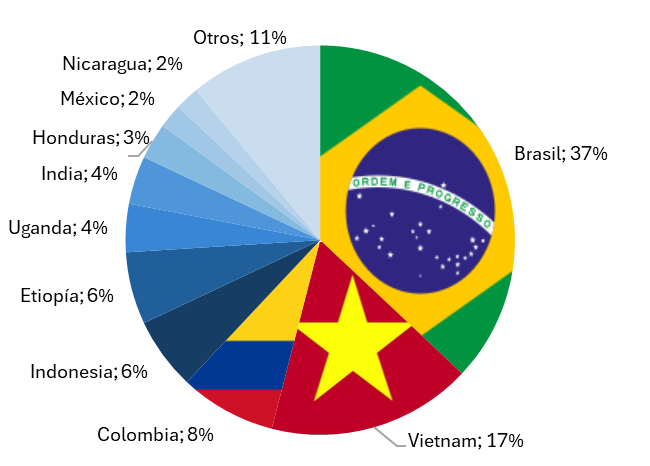
54% of the world's coffee supply today depends on only two countries: Brazil and Vietnam. While global industry is rapidly turning to the robust species and the price margin between New York and London is reduced, Colombia maintains its focus on the exclusive production of Arabic coffee. What is the opportunity cost if the country decides to ignore the highest growth segment in the international market?
Coffee Producers in the World
Source: USDA
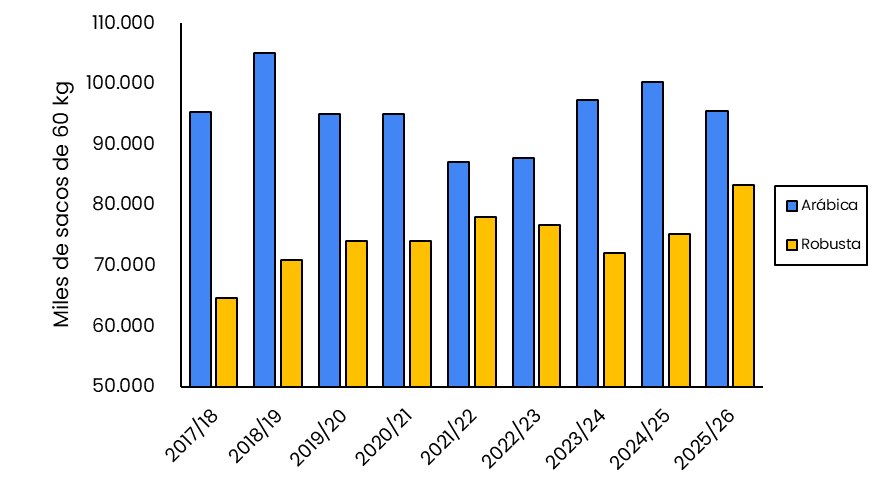
The coffee market is undergoing structural change. Historically, the Arabic dominated commercial demand. Today, driven by the soluble industry and inflationary pressures, consumption requires greater volumes of robust coffee (Cofea canephora). While this happens, climate change imposes thermal barriers that limit the production of the arabic, placing the robust as a more resilient and cost-effective alternative. Vietnam dominates Asian production and Brazil expands its local conilon variety, ensuring large-scale raw material for global torrefactors.
Production of Arabic and Robust Coffee
Source: USDA
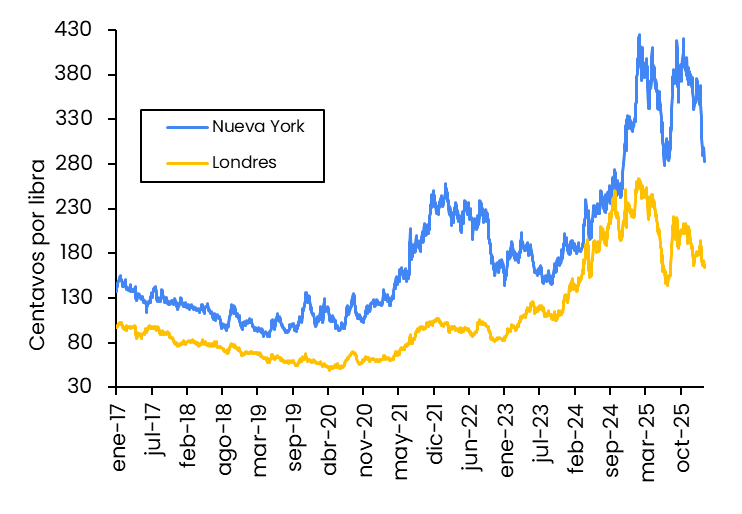
The mechanism of this transformation is direct. Global warming increases the maintenance of the arabic and reduces its viable growing areas; in the face of this cost increase, the industry reformulates its mixtures by replacing percentages of arabic with robust to defend its margins; this massive replacement increases the price of the robust in the London stock market, narrowing arbitration against the arabic in New York. The result is a market that rewards the agricultural efficiency of lowland.
Prices of Arabica and Robust Coffee
Source: Prepared by Asoexport with data from Intercontinental Exchange
This phenomenon directly affects Colombia's trade balance. Although the country exports 96 per cent of the Arabic it produces to capture high international prices, its domestic market demands 2.2 million sacks per year. The available local production does not meet this requirement. As a result, the national industry, particularly that of soluble coffee and extracts, is forced to import more than 1.17 million bags per year —72.6% from countries such as Brazil, Peru and Vietnam, mostly exporting robust coffee or low grade Arabic— allocating more than $400 million to the purchase of raw materials.
A frequent error of the sector is to assume that the cultivation of robusta will compete territorially with the arabic or will dilute the quality mark of the country. The agronomy indicates the opposite: the robust requires thermal floors less than 900 meters above sea level, dissolving the traditional Andean area. Another error is to stigmatize the species's cup profile, not knowing that the controlled after-harvest benefit protocols already allow to market microlets under the premium category of "Fine Robust."
Strategic action is to develop new agricultural borders through strict zoning. Regions such as the Orinoch (Meta, Casanare) and the Caribbean (Córdoba) offer plans suitable for a robust business model on farms of 50 to 100 hectares with mechanized collection, focused on cost leadership. In parallel, areas of the Litoral Pacific such as Tumaco allow associative models in areas of 3 to 5 hectares. With a yield of 40 sacks per hectare, 25,000 hectares would be sufficient to produce one million sacks per year, representing only 3% of the area for coffee in Colombia today. In addition, this production would take advantage of the 283 trillators installed in the country, which now operate only 60% of its capacity.
Si la participación global del robusta sigue creciendo y Colombia mantiene su restricción de cultivo, la industria liofilizadora nacional continuará destinando recursos a importaciones y se desaprovechará la oportunidad de integrar millones de hectáreas a la economía lícita. Si el país avanza en su adopción regulada, se habilitará la sustitución directa de importaciones y se generará una agroindustria eficiente en zonas que requieren alternativas productivas.
La incursión en el café robusta no representa una amenaza para la caficultura tradicional, sino una adaptación necesaria para la competitividad del país. Es el momento de estructurar las reglas de juego institucionales para formalizar este cultivo, retener el valor en la cadena nacional y garantizar el protagonismo de Colombia en el futuro global del café.