This picture is accelerated by an increasingly strict international regulatory framework, exemplified by regulations such as the Regulation on Deforestation-Free Products (EUDR) or the Corporate Sustainability Reports (CSRD) Directive. The main toaster firms are setting binding targets of zero net emissions by 2030 or 2050. Since the vast majority of these targets depend on range 3 emissions —those generated in the supply chain outside the direct control of the corporation—, the transformation of the production matrix at the farm level is the main channel for meeting these commitments. It is here that the cost-effectiveness of the sustainability of the cafes can intervene, allowing to turn the tree canals into a transportable asset.
Climate models anticipate that the world surface suitable for coffee cultivation could experience a severe contraction of between 50% by 2050, according to the blog ofInter-American Development Bank. It is crucial to analyse the impact of the coffee sector on the environmental footprint. According toCoffee, Forest and Climate AgreementIn Colombia, an average of 3.9 Kg CO is issued2Eq / Kg PCS (carbon footprint of coffee expressed in kilograms of carbon dioxide equivalent). It is estimated that more than 75% of emissions are generated before the green grain leaves the farm, mainly due to the use of fertilizers, the change in soil use and some processing methods. Environmental impact mitigation is no longer a tangential initiative to consolidate itself as a determining variable in the financial and competitive survival of the sector.
The monetization mechanism is based on the carbon capture capacity of the Agroforestry Systems (FAS). Unlike monocultures at free solar exposure, the SAF emulate the stratified structure of a tropical forest. The ground metrics show that these systems store on average 80% more total carbon, distributed between the organic carbon of the soil and the living biomass of the shady trees and bushes. This capture delta is audited by independent entities (VVBs - Validation and Verification Agencies) under global schemes such as Verra or Plan Vivo, allowing to issue certificates or bonds equivalent to a metric ton of CO-removed.
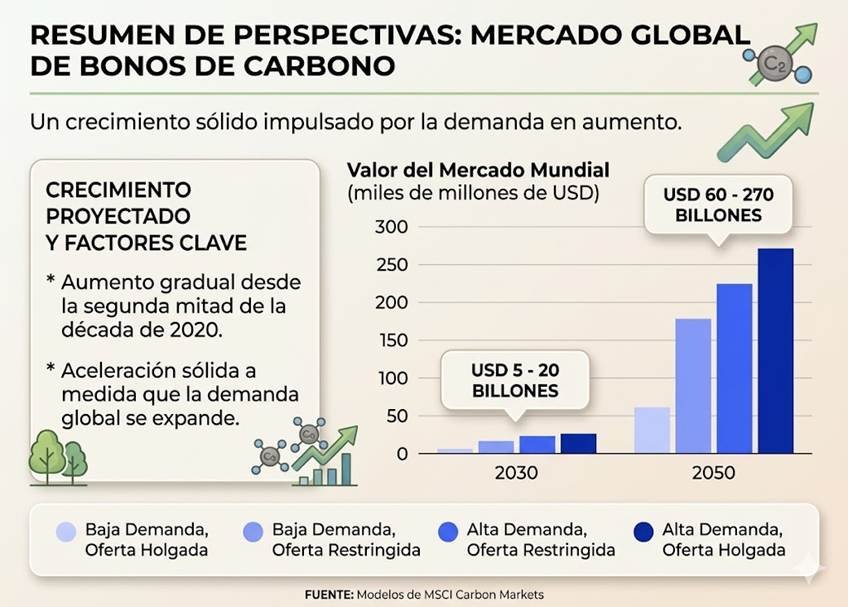
The voluntary carbon market has matured towards a clear price bifurcation based on project integrity, highlighting the search for the quality initiative. While theGeneral compensation appropriationswere transferred close to USD 3.5 during 2025, the bonds linked to higher quality solutions reached USD 6.8 in 2025. Despite the unquestionable ecological virtue of the FAS, mass adoption depends on the financial viability of the small producer and the effective direct transfer of prices.
For the exporting sector, the consolidation of these schemes is reflected in the obtaining of credits such as the ICONTEC Neutral Carbon label. The ICONTEC "Neutro Carbon" seal ensures that the organisation has measured, verified, reduced and finally compensated 100% of the residual emissions of its operations. The process to obtain and maintain this certification includes rigorous methodological stages, guided by the Colombian Technical Standard NTC ISO 14066-1 and GHG Protocol guidelines.
Una acción estratégica fundamental en la reducción de huella de carbono de la logística exportadora es la transición del transporte de carga por carretera hacia plataformas multimodales. La movilización ferroviaria de 160 toneladas de café desde la zona andina hasta los puertos del Caribe documentó un consumo de combustible de 153 galones de diésel, frente a los 650 galones que hubiera requerido una flota de tractocamiones. Esta eficiencia se traduce enemisiones 4.5 veces menores, un activo de información indispensable para las corporaciones que consolidan la huella total del producto en los mercados internacionales.
A pesar del potencial analizado, la materialización de estos esquemas enfrenta obstáculos estructurales que requieren intervención institucional. La adopción de prácticas orgánicas por sí misma no garantiza estabilidad financiera; los datos demuestran que, si no se compensan los mayores costos laborales de la producción orgánica con la monetización simultánea de servicios ecosistémicos, el modelo no es financieramente sostenible. Asimismo, los altos costos de transacción en la medición física de la biomasa amenazan la viabilidad de los pequeños predios. La respuesta técnica requiere implementar plataformas tecnológicas que monitoreen de manera masiva los predios, reduciendo fricciones y asegurando que un porcentaje mayoritario de los ingresos retorne al productor, evitando riesgos reputacionales para el café colombiano.
El desafío ya no es únicamente optimizar el rendimiento productivo del café, sino lograr integrar al sector en la arquitectura de la economía verde. Para los caficultores, la combinación y apilamiento de incentivos por carbono, cuidado de la biodiversidad, origen trazable y certificaciones premium representa el camino comercial más robusto para protegerse frente a la variabilidad de los precios en las bolsas de materias primas. El sombrío y la estructura forestal son ahora una oportunidad de infraestructura financiera que debe ser medida, verificada y transada con precisión técnica y rigor.
Para profundizar en el análisis de estas arquitecturas de financiamiento sostenible y las actualizaciones normativas que van a regir el futuro de la exportación de café, Asoexport los invita a participar en la90ª Cumbre Cafetera. Este espacio fundamental para la planeación sectorial tendrá lugar los días5 y 6 de noviembre de 2026en elHotel Hyatt Regency de Cartagena. Articular las estrategias sostenibles será decisivo para asegurar el liderazgo de la caficultura colombiana en los mercados internacionales